
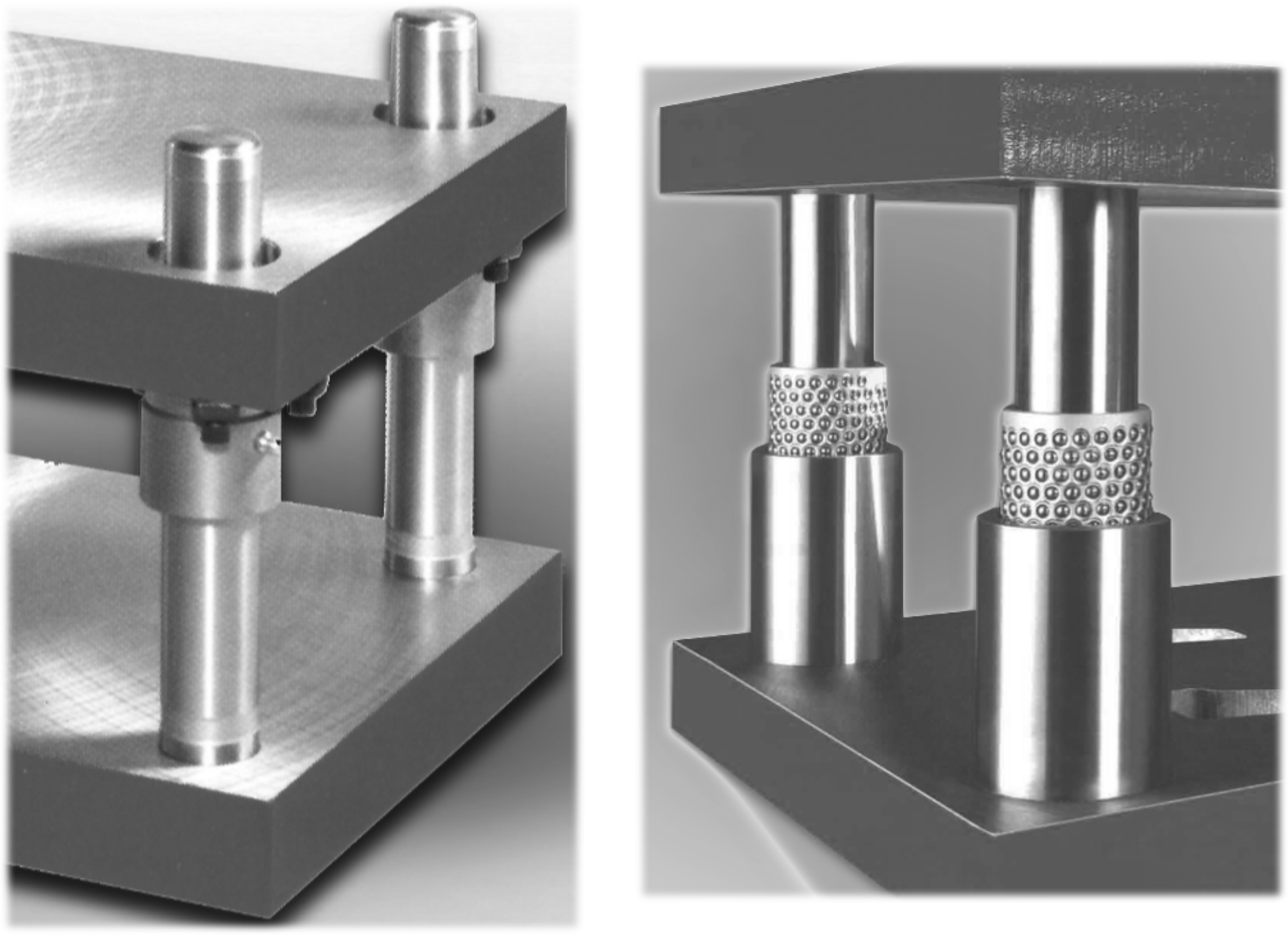
The right guidance choice is application driven.
Ball bearing and plain bearing die sets can both run excellent parts, but they punish sloppiness in different ways. The bearing choice should follow the application profile: stroke, speed, off-center loading, expected side thrust, how often the die is opened for service, and how disciplined your lubrication and cleaning habits really are (not the habits you want to have).
Start with a couple of honest questions; What are you asking the die set to forgive, and can any die set really guide / correct a sloppy press?
Ball bearing die sets reduce friction at routine production speeds. They’re typically chosen to reduce sliding resistance in the guiding system, keeping the upper and lower aligned with less heat build-up and less stick-slip during travel. That makes them a strong fit for higher-cycle tools where the run rate never really lets things cool down, and in applications where the die is spending most of its life running, not sitting idle or being torn down for maintenance.
Plain bearing die sets (bronze/steel, steel/steel, cast iron/steel, or other bushing/guidepost combinations) forgive abuse—or at least, fail more predictably when abuse shows up as contamination, mis-lube, transverse/thrust loads, or a maintenance routine that’s more “whenever we can” rather than scheduled. They’re simpler, and they don’t have rolling elements that can Brinell, spall, or get easily contaminated.
Stampers can get burned in assuming ball bearings are “better” in every case, however. They’re better at what they’re built for. Same with plain bearings.
A few decision flags that hold up across most applications:
- If you’re running high speeds with close punch-to-die clearances and you’re concerned about friction / heat, ball bearing guidance earns its keep.
- If you expect side load (progressive or transfer dies with heavy forming, off-center hits, angular/cam action), plain bearings often tolerate the reality better—especially if the guiding system sees any shock.
- If the tool is frequently opened for tryout, sensor work, slug clearing, or short-run scheduling, plain bearings are forgiving. Ball bearing systems can get cranky fast if the handling is rough or if debris gets worked into the rolling path.
- If your plant sees grit / dirt—think winter salt/sand tracked in, or the kind of airborne fines you get around grinding—plain bearings tend to survive better.
- If the die is a traveler (moved between presses or plants), the better choice is the one whose maintenance and handling discipline will actually happen at each stop. That’s an operational constraint, not an engineering one.
Compressed truths that usually land hard; Dirty dies, questionable lube program, unmanaged side loading. You already know where this goes.
You’ll also hear “ball bearing die sets cost more.” Often true, but it’s not the purchase price that hurts. It’s the cost of chasing alignment after the guiding system gets damaged and starts translating into punch wear, die button chipping, and mystery burrs. Think about the long-term cost of ownership over the short-term initial purchase price.
A realistic budget note for buyers: a quality guided set with rolling elements can be a noticeable jump—often a noticeable cost increase over a comparable plain-bearing configuration once you specify reputable components and the fit you actually need. The bigger number is the downtime and rework if the guidance decision is wrong for the job.
Ball bearing die sets: speed with rules
Ball bearing die sets shine when the press is doing what presses do best: providing repeatable, balanced, steady motion. When everything is aligned, they run smooth, reduce sliding friction, and keep the guiding action consistent at higher speeds. They can also make a tool feel “lighter” to the press—less drag on the way down, less heat in the guide system, and less tendency to stick/seize at top or bottom.
That’s the educational version. Here’s the shop-floor version: A ball-bearing die set is like a performance car. Keep it clean. Feed it right. Don’t take it down a gravel road and act surprised at the result.
Where they make real sense
- High-cycle or high-speed blanking and piercing where the die set is basically a dedicated runner and stays running for long periods.
- Tight tolerance demands.
- Presses that are in good mechanical health (gibs, bolster flatness managed, ram parallelism checked). A ball bearing guide can’t “fix” a press ram that’s walking.
What usually fails first (and what it looks like)
Ball bearing guidance doesn’t normally fail gently. A few common patterns:
- Brinelling from shock loads: A hard hit (misfeed, double part, slug stack) can cause dents in raceways. After that, you’ll feel “notchy” travel and see alignment start drifting under load.
- Contamination event: One bad cleaning cycle—compressed air blasting debris into the bearing path, or a die set placed on a dirty bench—can instigate damage that keeps growing. Rolling elements don’t “embed” grit the way some plain bushings can; they roll it.
- Cage damage: Rough handling of the die set during die changeover or die setup can deform cages. Once the cage is compromised, everything starts eating itself.
The ugly part is that these failures can masquerade as punch wear or die clearance issues. People start grinding, polishing, shimming, and “touching up” the cutting edges, and the guide system keeps steering the upper off-axis the whole time.
A field story (because the lists above don’t fully capture the feel)
“We had a progressive die running fine, then it got pulled, moved, and dropped into a different press line for a rush job. Nothing exotic. Same material family, similar tonnage. After the move, it started making a burr that wandered station to station. The toolroom did the normal stuff: checked feed, verified shut height, checked pilots, replaced springs, touched-up die buttons, sharpened punches, etc.
What fixed it was boring: the ball bearing guideposts had taken a hit during the move and setup. The die traveled “smooth enough” in the toolroom, but under load in the press it was steering. Once we stripped it down, you could clearly see the raceway damage and the track like a signature. That’s the sort of failure that makes people distrust ball bearing sets, even though the root cause was handling discipline.”
Practical rules that keep them alive
These may not be fun rules, but they’re the ones that keep you from buying the same components twice:
- Stop using compressed air like a broom around the guide systems. Blow-off belongs away from the bearing path; wipedown or vacuum beats blasting grit deeper.
- Treat die handling like precision work: clean lifting straps, clean bench, clean everything.
- Confirm lubrication method and interval: rolling elements want consistent lubrication, not “whenever someone remembers.” If you don’t have the staffing for it, that’s a management constraint.
- Account for side load: if the tool generates side thrust, plan how you’ll control it (die design balance, added guiding strategy, or accepting that plain bearings may be a better match).
- Watch for the confusing symptom: “It runs fine until the press warms up.” That’s often the hint of a guide problem, and the longer it runs, the more expensive the post-mortem fix.
- A ball bearing die set is worth it when you need precisely controlled motion at speed.
Plain bearing die sets: forgiving and predictable
Because the “best” plain bearing setup depends heavily on specifics: the bushing material system (bronze vs. steel vs. iron), the guidepost finish/hardness, and whether you’re dealing with measurable side thrust from cams or off-center forming, etc. Add to this the press condition and the lubricant you’re allowed to use (some plants ban certain oils for downstream cleanliness). If those constraints are known, picking a plain bearing set gets straightforward, and the next step is confirming your load case and contamination risk.
Plain bearing sets tend to make sense when the plant environment and the die’s real loading are messier than the idealized model. They’re often chosen for tools that see side load, intermittent running, or handling that isn’t gentle. In the Great Lakes region, where humidity swings and winter grit are normal, that “messy” factor shows up more than people like to admit.
Here’s what surprises teams switching from ball bearing to plain (or spec’ing plain for the first time): the die can run great, but it will tell you the truth about lubrication. Too little and you get galling and stick-slip. Too much and you attract fines that turn into lapping compound. There’s a narrow middle ground that works.
Cost-wise, plain bearing sets can be the more modest bill—parts cost varies by size and supplier. The expensive scenario is when the guide posts get scored or tapered and you’re chasing alignment with shims and prayers.
To wrap this with one sentence… Match the guidance style to the work, the side load condition, and the housekeeping you can realistically deliver—and your parts will tell you you’ve got it right.